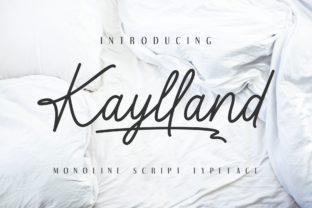
Kaylland Handwritten Font for Crafters & Sellers
As someone who designs printable wall art, hand-poured candle labels, wedding welcome boards, and SVG cut files for Cricut and Silhouette users, I’m always hunting for a handwritten font that feels personal—not precious—and works hard on real products. That’s why Kaylland has become my go-to script font in the Script Amp collection. It’s not just pretty; it’s smart, legible, and built for making physical goods that customers love to hold, hang, or gift.
Kaylland is a modern handwritten typeface with relaxed rhythm, subtle bounce, and just enough flair to feel intentional—not chaotic. Its letterforms have gentle contrast, soft terminals, and natural entry/exit strokes that mimic confident pen-on-paper movement. What makes it special for crafters? It doesn’t sacrifice readability for charm. Unlike some overly decorative scripts, Kaylland holds up beautifully at small sizes—think 8–12 pt on product tags or 16 pt on sticker sheets—and stays crisp when cut on vinyl or printed on kraft paper.
I’ve used Kaylland across dozens of tangible projects: lavender-scented soap labels where the font’s warmth echoes the handmade vibe; minimalist baby shower invitations where its light elegance balances clean layout; rustic farmhouse signs laser-cut from birch plywood; and even heat-transfer vinyl on organic cotton tote bags. Each time, it adds quiet sophistication without shouting. Customers notice it—they tell me their guests asked, “Where did you get that beautiful writing?” That kind of emotional resonance isn’t accidental. It’s built into Kaylland’s design DNA.
For printable creators, Kaylland shines in planner stickers, habit trackers, and quote-based wall art. Its lowercase ‘g’, ‘y’, and ‘f’ have friendly, open shapes that avoid visual clutter in tight grid layouts. When layered over watercolor backgrounds or textured paper mockups, it feels tactile—not digital. And because it’s designed as a display font first, it performs best for short, high-impact text: names on wedding place cards, boutique shop names on packaging tape, seasonal greetings on holiday mugs, or brand slogans on enamel pins.
Readability matters most when your font hits the cutting mat. Kaylland’s spacing is generous, and its letters don’t tangle—even at 0.25" height on die-cut sticker sheets. I tested it on my Cricut Maker 3 with fine-point blade settings, and every curve cut cleanly. No overlapping joins, no fragile serifs snapping off. For Silhouette Studio users, I recommend converting to outlines before sending to cut—especially if using swashes—but the base character set flows smoothly without extra cleanup.
Kaylland includes OpenType features like contextual alternates and discretionary ligatures, which let you swap in more expressive versions of common letter pairs (like “Th” or “an”) for custom greeting cards or monogrammed tea towels. It also supports multilingual Latin characters—so if you sell bilingual baby announcements or French-inspired apothecary labels, you’re covered. Files come in OTF and TTF formats, compatible with Canva, Adobe Illustrator, Procreate (via iFont), and Cricut Design Space.
Pairing Kaylland thoughtfully elevates your whole design system. I often combine it with a neutral sans serif like Montserrat or Poppins for body text on invitation suites—Kaylland handles the headline, name, or date; the sans serif grounds the details. For packaging, I’ll layer it over a warm serif like Cormorant Garamond for ingredient lists or care instructions. The contrast creates hierarchy, clarity, and quiet luxury. Avoid pairing it with other heavy scripts—it’s expressive enough to stand alone.
Real talk about licensing: Kaylland is a commercial font, meaning you can use it to create and sell physical products (candle labels, wooden signs, embroidered patches), digital downloads (PDF planners, Canva templates, SVG bundles), and client work (like designing a local bakery’s menu board). Just make sure your license covers the scope—most Script Amp fonts include extended commercial use, but always double-check the terms before listing printables on Etsy or bundling fonts into editable Canva templates.
Where Kaylland truly earns its place in my workflow is in consistency. When I launched my line of herbal tea blends, I used Kaylland across everything: the front label, the thank-you card tucked inside each box, the Instagram story highlight icons, and the chalkboard-style shelf signage at local markets. That repetition builds recognition—not just for my brand, but for the feeling behind it: thoughtful, grounded, quietly joyful. Customers begin to associate that handwriting style with quality and care.
It’s also forgiving for imperfect printing. On uncoated stock or matte sticker paper, Kaylland’s slightly rounded edges soften minor ink spread, unlike ultra-thin scripts that turn muddy or break apart. And for seasonal craft sellers, it adapts effortlessly—swap out colors, not fonts. A deep forest green Kaylland says “Christmas Eve,” while coral and cream says “Summer Picnic.” Same typeface. New mood.
If you’re choosing a script font for your next batch of physical or digital products, ask yourself: Does it look handmade *and* hold up under production? Does it invite attention without demanding it? Does it support your voice—not drown it out? Kaylland answers yes to all three. It’s not flashy. It’s not trendy. It’s simply one of those rare handwritten fonts that feels like it was made for makers who value both beauty and build.